Showing posts with label school free. Show all posts

Tuesday, May 3, 2016

The Responsibility of Home Educating

Many parents feel that they couldn't cope with the responsibility of educating their children themselves and are grateful for the school system. Parents are usually their children's most significant and influential teachers, regardless of whether or where their children attend school. But I understand that the idea of shouldering that responsibility solely seems overwhelming. I also understand that to the untrained eye it may seem that homeschoolers do shoulder this overwhelming responsibility. But let me tell you a little known secret: homeschoolers are not alone on a desert island.

We are not alone in carrying the responsibility for our children's education, we share it! We have family members who favour certain subjects over others, we have extended family members and friends we outsource to, on occasion. Many of us have tutors we regularly employ to share their knowledge and skills. We have a metric shitload of activities paid and unpaid that our children are involved in that are facilitated by others, or we free range it.

For example, on Mondays we have a nature walk group we spend the day with. During this time there's a hike most families go on together, and the kids run ahead. Then we have picnic lunch and the kids are left to their own devices, playing and learning together in which ever corner of the outdoors we've set ourselves up in, while the parents talk, eat, some of us crochet and we all parent, often kid swapping as the need arises, or simply because we were closer to the child than her parents at that moment. This is an example of free ranging their education.

Then there are the community activities our children participate in with their schooled peers. In our family these include basketball training, workshops and games, dance class, childcare/playgroup at community centres, swimming lessons, lego club and little athletics. Those are just the weekly group activities, there are also annual festivals we attend and random events (especially during school holidays, during the school holiday's councils go crazy putting on activities to entertain and educate children).

In our local homeschool community we have a few paid group activities such as weekly "sports", similar to school phys ed classes, but with more emphasis on fun than competition. We have sewing circle  where one mum and her daughters help the group to learn how to sew and complete a project each week and music class where a music teacher plays musical themed games, sings to the children and provides them with a variety of instruments to try. There are so many more activities we could take up, but we're very busy with what we do already.

Our family hires private tutors for violin lessons and in the past for learning a second language, though at the moment we're using a Youtube channel and online worksheets to teach ourselves Australian sign language. We also have "Molly Day", once a week when the girls babysitter spends half a day with them so that I can get some work done, or go to uni. She takes them to the museum, library, playground, or they play at home.

For all these scheduled activities there are ten sporadic playdates and catch-ups with other homeschool families where the kids learn from each other. They have different interests and participate in different activities and then bring all that experience to one another's lounge rooms and backyards. The kids also bombard their friend's parents with questions or simply soak up new information from being engaged in conversation with their friend's parents. One of the things I love most about our home ed community is that the other parents are genuinely interested in my children's lives and enjoy talking to my children, learning about their interests and sharing their own with the kids. I love the lack of age segregation in the homeschooling community. My children are used to socialising with people of all different ages. The other day there was a group of fifteen or so kids all playing together, some were as young as three and others were sixteen, and everyone was having fun. I would not have believed such a thing were possible had I not seen it with my own eyes. It is so great for the little kids to have that attention from older kids which makes them feel special, and for the older kids to get to feel the honour of nurturing young children and imparting their wisdom. All of the children get some context and perspective from being exposed to people of many different ages. These sorts of interactions make me think: if school is preparing children for the real world, homeschool is the real world.

When it comes down to it, I don't feel overwhelmed by the responsibility of teaching my children. Education can't help but happen when you lead a life as rich as ours. I feel that the burden of exposing my kids to new perspectives, information, opportunities etc is shared between the many adults in our community, as well as the other homeschooled children (and some of those children are starting to get a bit adulty with their aging and what not). I am constantly inspired by my friends who try new things, share their photos online or tell us what they've been up to lately. I steal from them (because "that's what creativity is!" one of them likes to tell me) and likewise share my ideas with them. Every now and again one parent will say "everyone come to our place and learn X!" Most often it is our children driving the curriculum, they inspire one another. Even if I were determined to stop my children from learning anything, I'd fail.

Homeschooling is an entirely different culture from living with school. While many of my friends can't imagine spending all day with their children, or being responsible for their education, the flip side is me: completely awestruck that anyone has the power to get a houseful of people out of bed, dressed, fed, groomed, out the door and to a school gate with lunch already packed by 9AM every week day.
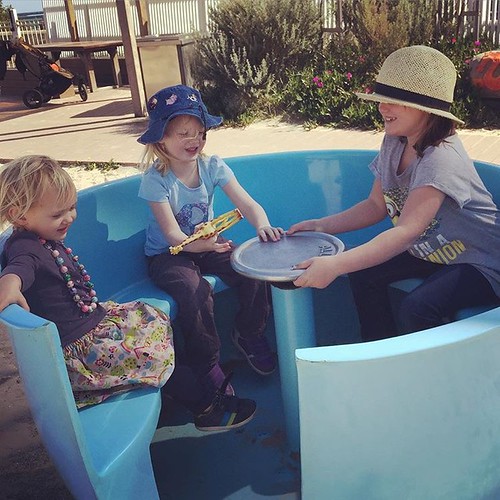
a few of our home ed kids at weekly sport event

Friday, April 29, 2016

Reading: " just another screen"

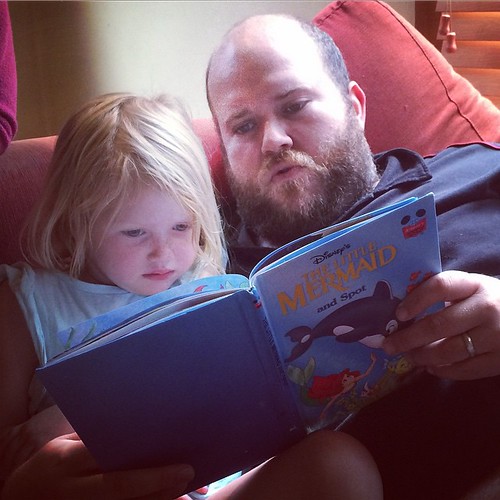
Yemaya was obsessed with this book for a while
When Eale and I were child-free and imagining our future together we thought parenting would be like living in a book club (cue laugh track). We love reading. So it seems only fitting that as yet none of our children have been bitten by the book-love bug.

This is cause for most of my homeschooling anxiety. I worry about my children's future, I worry about what others will think, I worry about all the wonderful moments and stories my children are missing out on having because they can't yet read. Eale, on the other hand, is a faith-keeper. He does not sweat this stuff. He knows how wonderful reading will be when the kids come to it, but he is happier than I to let them come to it in their own time.

Every now and again I get all up in my head about having an eight year old who doesn't read. I remember devouring chapter books of The Sweet Valley nature at her age. I wonder how much of my concern is truly for Gaia, and how much is about my own preconceived notions of parenting and education and what "successful" and "smart" look like. When these moments came in the past: I sat with G and coaxed her into reading and it was not fun. I've handed the reins over to Eale and let him be the parent she reads with. We both agree that Gaia can read when she wants to, but she rarely wants to. If she doesn't want to read and you sit down and ask her to, she tunes out...she magically unlearns everything she knows about the alphabet and phonetics. It's reached the point where Eale and I feel like we're being punked.

Friends have reassured us with tales of their own children who were late to reading. Other friends reassure us that eight isn't that old or far behind, and speak of Steiner and Waldorf. But what really made me relinquish my reading paranoia was what a friend referred to as his "controversial" opinion that "reading can be just another screen."

My mind melted at the theory that books are not the holiest of holy items we hippy-esque parents imagine them to be. Books could simply be another product in the endless pile of stuff sold to us as childhood entertainment. Think about it...I remember getting in trouble with family for having my nose in a book and being anti-social, the same way adults spin out about kids and their screen time these days.

The friend who theorised that books are like screens went on to say that screens and reading share the potential to "steal childhood". Why do we worry about how much screen time our children are having? Screen time is not time in nature like climbing trees, it's not active like running around, it's not social in the way that playing with toys with friends is social. With their minds lost to the screens children can become disengaged from the world around them and it has the potential to become an addictive behaviour: favouring screens over "real life". Literally all of these criticisms can be applied to reading. In fact, both books and screens can facilitate socialisation and be used as educational tools, but for some reason many of us put books on a pedestal as the superior tool when there are many more talents the screens possess. 

There is another way that reading can "steal childhood": and that is through the pressure placed on kids to learn to read. When my friend made his controversial comment it made me think about the times I'd called Gaia to sit with me and a book. Calling her out of the moment to sit and read was extinguishing whatever learning she had deemed important. I was calling her away from her childhood.

Unschoolers suggest that you don't need to teach a child to read. Regardless of theory, our expert experience in educating Gaia has shown us that this is not a method that works for her. Thus, we need to stop. We were drawn to homeschooling because we wanted our children to learn the necessities at their own pace, when they felt ready. But loving the theory and living the reality are two different things. The theory appealed because a blissful cloud of delusion made pre-mother me think that my kids would value the things I value and learn the things I thought were important when I felt was age-appropriate. Turns out, my children are unique individuals!

The children will learn to read when they need to (that is, when they have a strong desire to do so). How do children learn to talk and walk? We model the behaviour, we immerse them in a culture of walking and talking, and they pick it up themselves to be part of our world. Our children want to connect with us: they want to talk with us, walk like us, and having us read books aloud to them is something else they like. We also allow them to play with books. They like to pretend to read thick reference books (Gaia cannot drag herself away from the reference section of the library, even though she has not yet mastered the art of reading children's books herself). They like to touch books, build with them, use them in games as stepping stones, plates and toy beds, to name a few. They see Eale and I reading, we make regular trips to the library, borrow books, have family reading nights and particular series we read together like The Magic Faraway Tree. We discuss books. The girls know I'm writing my own book and Gaia often dictates her own stories to me as scribe. Gaia also has a pen pal. My bet is, that in a reading rich environment such as this: chances are our children will be fluent readers one day.

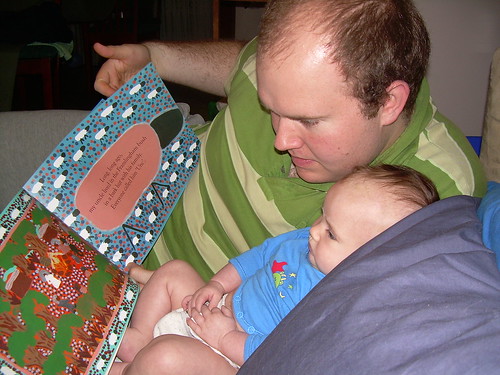
One of my favourite photos. 2008: Eale reading to baby Gaia


 Further reading on reading

Children teach themselves to read

Learning to read naturally 

Learning to read the Waldorf way

Myth Busting: How reading is taught in a Waldorf school

I'm Unschooled, yes I can read

Saturday, April 23, 2016

Autism & Unschooling: when Someone Else didn't check themself...

When it began to dawn on me that our daughter is not "just a little quirky" I felt guilty for not realising sooner than she may be on the autism spectrum. I shared this shame with my fully-grown autistic friend and she said: "You didn't realise because you were coping so well! You've always been really good at meeting your children where they're at." For that: I credit our school free lives. Unschooling means that I never expected my child to meet developmental milestones at the same time as her peers. Unschooling helps me be flexible and accommodating in negotiating how we spend our days and it gives my daughter more control over her life than if she were made to fit herself into a schooling schedule. Learning that she is autistic has not changed our education plans, but this was a concern for Someone Else.

Unschooling is working really well for each of our children. Our daughter doesn't need school to become a functioning adult, or to learn how to set and achieve goals. But, even if you put those things aside, we would not consider school for our autistic daughter because her anxiety and communication issues would make it incredibly difficult for her to participate in traditional schooling.

Homeschoolers know that if ever they express dissatisfaction with any aspect of their daily lives they will be met with "send the kids to school." So I should not have been surprised that Someone Else felt school would solve this autism problem too. When I made it clear school was not an option that's when it kicked off:
"Oh my heart! I feel so sad for her." Someone Else stated with melodrama. "What makes you think she couldn't cope with school?"
"I know my child and-"
"Everyone thinks they know their child but..."
What followed was a lecture in which I was told that I can't meet my child's needs, only school can do that. I was told that as her mother I underestimate my daughter's abilities and that if I sent her to school she could reach her full potential and stop being held back by me. I was doing my daughter a disservice by denying her enrollment to a special school (the assumption being that if traditional schooling won't work, surely a school for the developmentally delayed will).
 
If you're wondering how I could  let someone speak to me like this, just know that I have a lot of experience with being treated as subhuman. This sort of offensive, patronising rudeness is all part of the "having female genitalia" package. Also, by choosing to home educate your children you cease to be fully human because homeschooling is an "alternative lifestyle choice" ("alternative" being a code word for "unworthy of respect").

The implication that I am holding my daughter back reveals Someone Else's ignorance about autism. Sending her to school will not suddenly "correct" whatever it is about her brain that makes her anxious about groups of people, and transitioning between activities. She's not going to magically learn to speak clearly from school teachers and students (because if it were that simple she would already be speaking clearly from learning at home with us, jut as her siblings have!).

What is it about school that Someone Else wants for my daughter? In a mainstream school my child would have to compete with twenty other children for the attention of her teacher. Funding issues mean that she is not guaranteed an aid worker in class with her. At home the worst the teacher:child ratio gets is 1:4...but our active lives and local homeschooling community mean there are frequently many adults. Our daughter's music teacher pointed out that our daughter is highly intelligent and if she could get into a "special school" she would quickly be the lowest priority in a roomful of very needy little learners.

If I sent my child to school she would spend hours at a time in a single room with twenty other children her own age. At home she is free to spend her time in any room or outside. We spend a lot more time out and about than at home, though. My point is that she is never confined. If she becomes overwhelmed seeking refuge is simple.

If she is unready or unable to perform a certain task, we leave it be and come back to it when she is ready. She has a say in what she learns, how she learns, and when she learns it (same as her siblings). If we start a new activity we can give her plenty of attention and support preparing. If she's anxious we can take the time to work through it with her. We know what situations make her anxious, we know how to help her deal with these situations and the anxiety. We know when a little encouragement will help her try something new and we know when a little encouragement will cause her anxiety to spike. And for all the times that we don't know for sure: we try, we observe, we wait, we see, we adjust, and most importantly: we love.

No teacher, no matter how great, cares more about our child's welfare than we do (and teachers agree). Even the most devoted teacher is not there for our daughter, like we are as her educators. Teachers are there for everyone's daughters. Perhaps Someone Else thinks that teachers have advanced training in educating autistic children? Given the constant efforts of other parents working to make schools safe and supportive for their autistic children, I'm going to hazard a guess that there's not a teacher alive who understands autism better than the parents who live with it. From what I can tell it is generally the parents of autistic children who are raising the awareness, advocating for their children's rights and needs and working with teachers and the community to get a better system for their often bullied, shamed and misunderstood children. Furthermore, given the lack of understanding of autism in girls, even within the psychological profession, I don't have faith that the average school teacher is equipped to meet my daughter's needs in a classroom.

School would be my daughter's nightmare. An enclosed space for much of the day, many people in that space, her activities prescribed to her for a set amount of time and these activities stopping and starting frequently throughout the day. It would take a massive amount of physical, mental and emotional energy for her to survive the world of school. We don't have to do that to her, we can provide a learning environment better suited to her needs without school and she can save all that energy to focus more on the things that inspire her. Perhaps by giving her a school free education she can spend the energy she saves on not dealing with the classroom, on facing the challenges her neurologically diverse brain presents? In any case, despite the developmental, social and communication difficulties our daughter lives with, she is a happy and healthy little girl. She enjoys her life and is always learning. Just like her neurotypical siblings.

Look at all that disservice I'm doing these children by denying them the necessity of a classroom

Edited: Days after writing this post we discussed this issue with our daughter's psychologist, paediatrician and autism advisors from Amaze. The advisors and paediatrician recognised home educating as a legitimate choice and saw no reason to change our current approach with our daughter, the advisors emphasised that autism can't be caused or cured by anything a parent does. But what was most reassuring was the psychologist informing us that with an IQ like our daughter has she could not get into a special school even if we tried. It was her professional opinion that we were making the right choice for our daughter's education, that many families with autistic children make the same choice because it is the best way of meeting their learning needs, especially given mainstream schools can't afford to provide autistic students with the support they need. #vindicated

Tuesday, March 22, 2016

Manic Mondays

Just another "manic Monday" I chortle ironically. Another Monday with our nature walk group meant: many sun and sand filled hours at the beach with a handful of home schooling families.

Frida spent a full four hours digging holes, mainly with her fingers. I'm not sure she noticed anyone else was at the beach! She was totally consumed with her hole digging. In jest we call her our "little fezza" (feral) because she delights in this sort of play: where she gets grubby and comes home with miscellaneous black caked beneath her fingernails.

Yemaya ran around with the other kids for a while, but the outdoors, the people, it all got a bit much.  She buried herself beneath our towels with a my little pony and managed to keep herself content until everyone else was ready to leave (we were very grateful!). I checked on her regularly and she was happy so long as the towels covered her and she was left alone with the pony.

Gaia was a non-stop socialising machine. Sports on the sand, story telling behind the surrounding bush land, a lot of running, building and burying with sand, some splashing in the sea, she was all over it. After everyone left and we climbed into our car she devoured the contents of her lunch box, confessing between mouthfuls: "I was having so much fun I forgot to eat" (again!)

And why wasn't Mum making sure she ate? Too lost in her own conversation with another home ed mum. There's nothing quite like starting your week with occupied children, sunshine, while discussing religion, politics and health on the beach.

I don't envy our parallel universe selves who spent the day indoors working at desks, on tasks set by others. (On that note: thanks Eale for making today possible by working a thankless job so that one day the kids might not! xoxo)

Saturday, March 19, 2016

Doing Science (with fire!)


"I like to do science." Gaia says often.
"What do you mean, hon?" I asked, "What's 'doing science'?"
"Experiments! Where you change the colour of something."
This led to a discussion about what science is, what purpose it serves and how we go about 'doing science' for ourselves. But academics are not what Gaia craves, she'd already told us it was about colour, it was about the spectacle, she's after the performance art side of science.

Eale came across an at-home science experiment he thought Gaia might find fun. And I found a printable outlining the major terms and the process involved in "doing science" for future conversations.


Gaia and Dad's scientific investigation of fires' need for oxygen.

THE SCIENTIFIC PROCESS

Choose a problem: Does fire need oxygen to live, like we do?

Research your problem: (this part involve pre-reading and researching the ideas. In this case Dad did that and came home with the experiment...Gaia just wants to do the experiments, not waste her precious free spirited/8 year old time with research).

Develop a hypothesis: Fire needs oxygen to continue burning

Design an experiment: 3 identically sized candles lit, 3 different sized glass cups placed over a candle. Observe to see how long each candle stays lit.

Test your hypothesis: See photos below

Organise your data: 8 year old likes to organise her data with an oral presentation to anyone who will listen :) She observed that the candle under the largest glass burned longest, candle under the smallest glass burnt out fastest.

Draw conclusions
: the more oxygen available to the candle flame, the longer it will stay lit. Fire needs oxygen.


Tuesday, March 15, 2016

White Australia's Black Past, an introduction.

Today's book learnin' is brought to you by Mum's white guilt. Gaia was confusing refugees with Indigenous Australians, so we set to work clearing that up with a discussion about pre-history,  First Australians, European imperialism, colonialism, & reconciliation. 

One of the passages we read mentioned a shift in European thinking in the 1700s from enlightenment/all men are created equal philosophies to the hierarchical racist thinking which continues today, that European society is civilised & other cultures are inferior. The author suggested this shift occurred as Europeans came in to more frequent contact with First Nations peoples around the world. It was satisfying to see how utterly insane these concepts were to an 8 year old. She couldn't fathom anyone thinking one group of people are better than another. She believes difference is natural and important, that it makes the world a better place. Racism is learnt. 

We have just scratched the surface of White Australia's Black History, a subject we will never stop learning in this lifetime.

We pulled out Mum's fine arts books cataloging some of the work of Indigenous artists (art is Gaia's favoured language). We learnt that the legend of the rainbow serpent is the longest surviving belief in human history! She already knew a little about ancient indigenous art and "dot paintings", but we also took a look at some more contemporary works. It's important for all Australians to understand that our black history is not in the past, and to begin this with Gaia, we've started appreciating a wider range of art by 20th and 21st century First Australian artists.

Once she grasped the fundamental difference between Indigenous Australians and refugess (the former being The First Australians, here for tens of thousands of years and the later coming to Australia for the first time, in search of safety) we explored some of the links between Indigenous Australians and refugees. This links included: European Australian racism and hypocrisy, and draconian governmental approaches to the issues faced by both groups (though I may not have used the word "draconian").

It was a lot to take in, but she is hungry for more, and I'm relieved I didn't overwhelm her. I resent the way
our black history was taught to us in school in the 80s and 90s (though I recognise I was fortunate to attend schools that mentioned it at all!). Australian history was presented in an Us Vs The fashion, which left students with the impression that Indigenous Australians were whiney and stuck in the past. It certainly was not taught in a way that promoted a thirst for more knowledge or desire for reconciliation or treaty. I was determined not to let that happen at our home school.

Beach Therapy

We needed today quite badly. We have been having a challenging time this past...year, but especially the last six months. Today we managed to shake some of the stress, exhaustion, hurt & worry off with a day at the beach. For a really wonderful change, we had Ealesy with us on a Monday, so the whole family went to the beach, where we met up with a few other home ed families.

The six of us scaled the rocks and sand for every shell we could find (which will be used to fashion mermaid crowns in the near future). Watching Yemaya & Frida get lost in the task was especially wonderful. Children are so divine when they're deep in their private universe, focused and determine. It's a personal and very love-filled form of meditation to quietly stand by and watch them at the work. They somehow simultaneously bring you back down to earth while carrying you away to another world.
 

In a rather epic role reversal: Yemaya didn't want to leave, and Gaia was the first to ask for home! This was a testament to how engrossing the sea shell collecting caper was to our dear May.

We inspected a rock face that was a little cave-like, strolled through rock pools and played on the sand with buckets, shovels & a ball. There were hand stands and laughter and lots of conversation. There was also a great mix of home schooled kids and parents of many ages (and they worry about socialisation!)

In addition to all the great folks at the beach, we also met this little fellow, who completely delighted the children:


'twas another #blessedasfuck day;)

Monday, February 8, 2016

Not-The-First-Day Back with HEN

Every year the home education network in our state organises a "Not back to school" day at water slide theme park. It's what keeps us parents home schooling through our darkest days ;) 2016 did not disappoint.

It all went down in a very us fashion, with one child too small for waterslides and two others who refused to ride them. One child plonked herself on the carousel and did not want to budge all day (to the point where Eale fell asleep on it as he accompanied her round countless times). And then there's that one kid who has to DO ALL THE THINGS who we lost for large chunks of the day to other families and sections of the park.

In related news Gaia's not bad with a bow and arrow, which was a pleasant surprise.


Tuesday, February 2, 2016

Bird, Baby, Beach & Basketball

We've an eventful start to the week. The day started with a magpie in the kitchen. She did not want to leave and our cat was too scared to shoo her away! We ended up leaving the back door open for her and dashing off to the many things we had planned, hoping that by the time we returned she would have seen herself off. 

We had an appointment with the maternal child health nurse to track Lenus' progress, followed by a few hours on a beach with a bunch of home ed families. Finally Gaia had basketball training.

The beach featured a massive rock pile the kids loved. I believe it had been assembled to protect the life saving club from rising tides. But as far as the children were concerned it was a mountain to be climbed, a series of caves to hide within, and a place to find hidden treasures. 

We also enjoyed the natural bubbles the sea had washed assure, taking a long stroll through them. It was a perfect afternoon catching up with some of our home ed friends in the community and making the most of the sea, sand and sun. 

Before heading home, I overheard Gaia discussing her day with one of the parents. The mother told Gaia she was very lucky to get to spend a school day at the beach. I could not agree more! We really are blessed to live this quirky school free life.


PS. We were relieved to discover Maggie had departed, when we finally made it back home at 6PM. Alas, the girls are now nursing some bird fear and have taken to not only closing the back door but also bolting it shut, lest a magpie should figure out the door handle!

Thursday, January 28, 2016

First Day (Not) Back

Today was our first day (not) back to school. Gaia would be entering grade 2 & Yemaya a second year of kindergarten. 

We spent the first day of the 2016 school year crafting with friends at their place, in the morning. Gaia created a cardboard land for the my little ponies (they are all obsessed with MLP right now) & the afternoon was spent playing with these. 

Gaia also invented a board game involving the land and ponies (it involved dynamite and a lot of death too #girlswillbegirls). Then Yemaya, Frida, Lenus and I read stories at the library while Gaia had her first dance class for the year. A rather fruitful not-first day back.
 
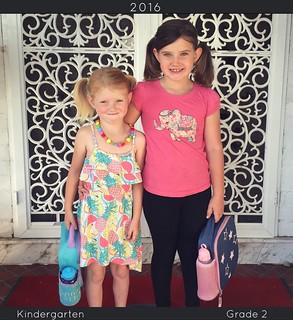
One of the many reasons homeschooling was the choice for us was a desire for our children to grow up grade-free. It's not reasonable to expect children to be capable of certain feats simply because of their age. It also isn't ideal to segregate children based on age. So it is amusing that every year we do the math and determine what grade they would be in if they were attending one of the local schools. For all my talk, I am a sucker for certain schooly traditions like the first day back snapshot (don't get me started, I've tried talking Eale into speech nights and an unschool Christmas play ;-D). This silly math game we play led to an interesting discussion about individuality in our family.

Life would be very different if we were in the system with Yemaya.  At her age Gaia could have started school, but Yemaya is not school ready, Realising this has made us grateful, once again, to be able to give our children this alternative start to life (it's also made us realise we need to find new ways to support Yemaya's learning that work for her, which will most likely require more involvement from adults outside the family, and stop coasting along expecting she will respond to activities and develop skills the same way her older sister did). If we had been planning to send Yemaya to school, last year would have been very stressful as we tried to get her school ready and find out why she's "behind" her peers. But there's no ticking timebomb, and whether she's "starting school" or "repeating kindergarten" is meaningless, because yesterday is no different from today in our learn-through-living style.