Showing posts with label childhood. Show all posts

Tuesday, May 3, 2016

The Responsibility of Home Educating

Many parents feel that they couldn't cope with the responsibility of educating their children themselves and are grateful for the school system. Parents are usually their children's most significant and influential teachers, regardless of whether or where their children attend school. But I understand that the idea of shouldering that responsibility solely seems overwhelming. I also understand that to the untrained eye it may seem that homeschoolers do shoulder this overwhelming responsibility. But let me tell you a little known secret: homeschoolers are not alone on a desert island.

We are not alone in carrying the responsibility for our children's education, we share it! We have family members who favour certain subjects over others, we have extended family members and friends we outsource to, on occasion. Many of us have tutors we regularly employ to share their knowledge and skills. We have a metric shitload of activities paid and unpaid that our children are involved in that are facilitated by others, or we free range it.

For example, on Mondays we have a nature walk group we spend the day with. During this time there's a hike most families go on together, and the kids run ahead. Then we have picnic lunch and the kids are left to their own devices, playing and learning together in which ever corner of the outdoors we've set ourselves up in, while the parents talk, eat, some of us crochet and we all parent, often kid swapping as the need arises, or simply because we were closer to the child than her parents at that moment. This is an example of free ranging their education.

Then there are the community activities our children participate in with their schooled peers. In our family these include basketball training, workshops and games, dance class, childcare/playgroup at community centres, swimming lessons, lego club and little athletics. Those are just the weekly group activities, there are also annual festivals we attend and random events (especially during school holidays, during the school holiday's councils go crazy putting on activities to entertain and educate children).

In our local homeschool community we have a few paid group activities such as weekly "sports", similar to school phys ed classes, but with more emphasis on fun than competition. We have sewing circle  where one mum and her daughters help the group to learn how to sew and complete a project each week and music class where a music teacher plays musical themed games, sings to the children and provides them with a variety of instruments to try. There are so many more activities we could take up, but we're very busy with what we do already.

Our family hires private tutors for violin lessons and in the past for learning a second language, though at the moment we're using a Youtube channel and online worksheets to teach ourselves Australian sign language. We also have "Molly Day", once a week when the girls babysitter spends half a day with them so that I can get some work done, or go to uni. She takes them to the museum, library, playground, or they play at home.

For all these scheduled activities there are ten sporadic playdates and catch-ups with other homeschool families where the kids learn from each other. They have different interests and participate in different activities and then bring all that experience to one another's lounge rooms and backyards. The kids also bombard their friend's parents with questions or simply soak up new information from being engaged in conversation with their friend's parents. One of the things I love most about our home ed community is that the other parents are genuinely interested in my children's lives and enjoy talking to my children, learning about their interests and sharing their own with the kids. I love the lack of age segregation in the homeschooling community. My children are used to socialising with people of all different ages. The other day there was a group of fifteen or so kids all playing together, some were as young as three and others were sixteen, and everyone was having fun. I would not have believed such a thing were possible had I not seen it with my own eyes. It is so great for the little kids to have that attention from older kids which makes them feel special, and for the older kids to get to feel the honour of nurturing young children and imparting their wisdom. All of the children get some context and perspective from being exposed to people of many different ages. These sorts of interactions make me think: if school is preparing children for the real world, homeschool is the real world.

When it comes down to it, I don't feel overwhelmed by the responsibility of teaching my children. Education can't help but happen when you lead a life as rich as ours. I feel that the burden of exposing my kids to new perspectives, information, opportunities etc is shared between the many adults in our community, as well as the other homeschooled children (and some of those children are starting to get a bit adulty with their aging and what not). I am constantly inspired by my friends who try new things, share their photos online or tell us what they've been up to lately. I steal from them (because "that's what creativity is!" one of them likes to tell me) and likewise share my ideas with them. Every now and again one parent will say "everyone come to our place and learn X!" Most often it is our children driving the curriculum, they inspire one another. Even if I were determined to stop my children from learning anything, I'd fail.

Homeschooling is an entirely different culture from living with school. While many of my friends can't imagine spending all day with their children, or being responsible for their education, the flip side is me: completely awestruck that anyone has the power to get a houseful of people out of bed, dressed, fed, groomed, out the door and to a school gate with lunch already packed by 9AM every week day.
a few of our home ed kids at weekly sport event

Friday, April 29, 2016

Reading: " just another screen"

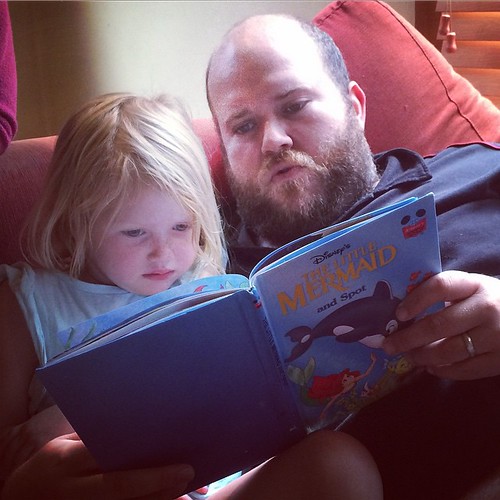
Yemaya was obsessed with this book for a while
When Eale and I were child-free and imagining our future together we thought parenting would be like living in a book club (cue laugh track). We love reading. So it seems only fitting that as yet none of our children have been bitten by the book-love bug.

This is cause for most of my homeschooling anxiety. I worry about my children's future, I worry about what others will think, I worry about all the wonderful moments and stories my children are missing out on having because they can't yet read. Eale, on the other hand, is a faith-keeper. He does not sweat this stuff. He knows how wonderful reading will be when the kids come to it, but he is happier than I to let them come to it in their own time.

Every now and again I get all up in my head about having an eight year old who doesn't read. I remember devouring chapter books of The Sweet Valley nature at her age. I wonder how much of my concern is truly for Gaia, and how much is about my own preconceived notions of parenting and education and what "successful" and "smart" look like. When these moments came in the past: I sat with G and coaxed her into reading and it was not fun. I've handed the reins over to Eale and let him be the parent she reads with. We both agree that Gaia can read when she wants to, but she rarely wants to. If she doesn't want to read and you sit down and ask her to, she tunes out...she magically unlearns everything she knows about the alphabet and phonetics. It's reached the point where Eale and I feel like we're being punked.

Friends have reassured us with tales of their own children who were late to reading. Other friends reassure us that eight isn't that old or far behind, and speak of Steiner and Waldorf. But what really made me relinquish my reading paranoia was what a friend referred to as his "controversial" opinion that "reading can be just another screen."

My mind melted at the theory that books are not the holiest of holy items we hippy-esque parents imagine them to be. Books could simply be another product in the endless pile of stuff sold to us as childhood entertainment. Think about it...I remember getting in trouble with family for having my nose in a book and being anti-social, the same way adults spin out about kids and their screen time these days.

The friend who theorised that books are like screens went on to say that screens and reading share the potential to "steal childhood". Why do we worry about how much screen time our children are having? Screen time is not time in nature like climbing trees, it's not active like running around, it's not social in the way that playing with toys with friends is social. With their minds lost to the screens children can become disengaged from the world around them and it has the potential to become an addictive behaviour: favouring screens over "real life". Literally all of these criticisms can be applied to reading. In fact, both books and screens can facilitate socialisation and be used as educational tools, but for some reason many of us put books on a pedestal as the superior tool when there are many more talents the screens possess. 

There is another way that reading can "steal childhood": and that is through the pressure placed on kids to learn to read. When my friend made his controversial comment it made me think about the times I'd called Gaia to sit with me and a book. Calling her out of the moment to sit and read was extinguishing whatever learning she had deemed important. I was calling her away from her childhood.

Unschoolers suggest that you don't need to teach a child to read. Regardless of theory, our expert experience in educating Gaia has shown us that this is not a method that works for her. Thus, we need to stop. We were drawn to homeschooling because we wanted our children to learn the necessities at their own pace, when they felt ready. But loving the theory and living the reality are two different things. The theory appealed because a blissful cloud of delusion made pre-mother me think that my kids would value the things I value and learn the things I thought were important when I felt was age-appropriate. Turns out, my children are unique individuals!

The children will learn to read when they need to (that is, when they have a strong desire to do so). How do children learn to talk and walk? We model the behaviour, we immerse them in a culture of walking and talking, and they pick it up themselves to be part of our world. Our children want to connect with us: they want to talk with us, walk like us, and having us read books aloud to them is something else they like. We also allow them to play with books. They like to pretend to read thick reference books (Gaia cannot drag herself away from the reference section of the library, even though she has not yet mastered the art of reading children's books herself). They like to touch books, build with them, use them in games as stepping stones, plates and toy beds, to name a few. They see Eale and I reading, we make regular trips to the library, borrow books, have family reading nights and particular series we read together like The Magic Faraway Tree. We discuss books. The girls know I'm writing my own book and Gaia often dictates her own stories to me as scribe. Gaia also has a pen pal. My bet is, that in a reading rich environment such as this: chances are our children will be fluent readers one day.

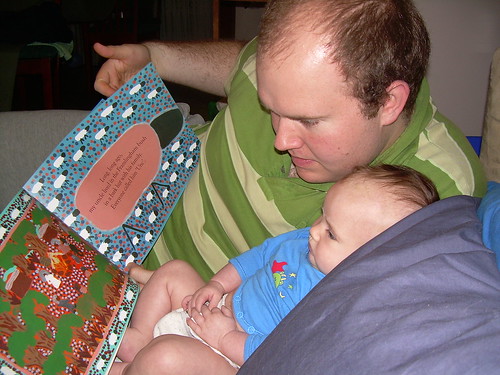
One of my favourite photos. 2008: Eale reading to baby Gaia


 Further reading on reading

Children teach themselves to read

Learning to read naturally 

Learning to read the Waldorf way

Myth Busting: How reading is taught in a Waldorf school

I'm Unschooled, yes I can read